/logo.webp)
How to Keep Characters Consistent in an AI Short Drama

Episode one looks like a show. Episode two looks like a cousin. The lead’s jaw is wider, the coat is a different black, the earring has migrated. You did not change the prompt that much. The model did not remember the person. Viewers do not say “inconsistent latent space.” They say the show recast the lead without telling them, and they leave.
That is the actual failure mode of serialized AI video. Clip quality is a lens-level problem. Character drift is a season-level problem. Most model-release posts brag about seconds per shot. If you are making a short drama, seconds are the wrong unit. A title dies when the face cannot survive the cut to episode two.
This is not a general “how to make a short drama” walkthrough — that already exists. This is the lock: look, wardrobe, light, and the one reference pass you do before you are allowed to generate episode two.
Table of Contents
- Why serialized AI drama dies from drift
- Lock the person before you lock the plot
- A reference pack that actually survives episode two
- Generate in batches that share a face
- Where to spend the longest shot
- Frequently asked questions
Why serialized AI drama dies from drift
A single beautiful clip is a demo. A short drama is a person the audience agrees to follow. When the person changes, the contract breaks.
The useful split is shot-level leverage versus series-level leverage. Duration, resolution, and motion smoothness are shot-level. Reference capacity — how many images, how much wardrobe, whether audio stays attached across cuts — is series-level. Kling 3.0 Omni’s own user guide describes a single generation that can cover multiple shots with shared native audio and lip-sync across languages. That is a series-level claim, not a beauty claim. It is also bounded: consistency holds inside one generation. It does not hold across a week of new sessions unless you re-feed the same pack.
I’d take a slightly softer clip with the same earring over a sharper clip with a new face. Viewers forgive grain. They do not forgive a recast.

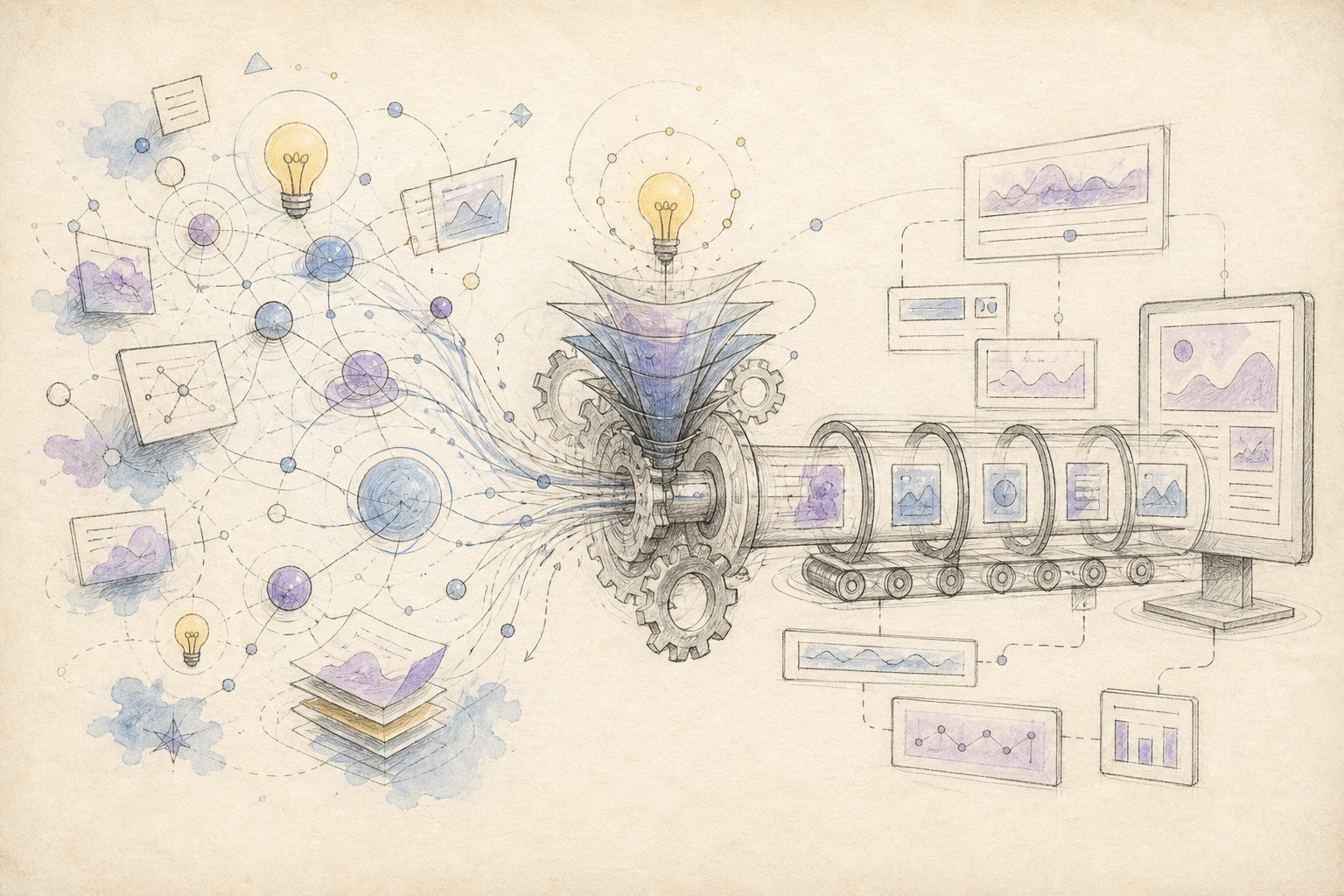
Illustration drawn for the production workflow — reused from the existing DramaSo image set.
If you cannot overlay episode one’s face on episode two and have the landmarks match, you do not have a lead. You have a slot.
Practical rule: Duration is shot-level leverage. Reference capacity is series-level leverage. Serialized stories die from character drift, not from clip quality.
Lock the person before you lock the plot
Do this on paper, once, before a generator sees the season.
Face. Three stills minimum: front, three-quarter, profile. Same hair, same makeup, same age. Write the landmarks a stranger could check: “mole under left eye, gold hoop in the right ear only, widow’s peak.” If it is not written, it will not be in episode 12.
Wardrobe bible. One outfit per story function, not per episode. “Navy coat, silver buttons, scuffed right cuff” is a bible line. “Looks rich” is a prompt that will invent a new coat every Tuesday. Limit palettes. The second the coat changes without a scene that shows the change, you recast.
Light. Pick a key direction and a color temperature for the show, not for the shot. Mixing noon and neon across a conversation is how the same person becomes two people.
Voice and body tells. A limp, a left-handed pour, a habit of touching the necklace. These are cheap continuity locks because they survive even when the model slightly melts the jaw.
Fill a character profile template until those four blocks are boringly specific. If you are still inventing the person, use the OC generator for name, look, and flaw — then freeze the output. Do not keep rolling. Rolling is how you get a new lead.
The plot can still move. The person cannot, unless the episode is the transformation and you planned the before/after as two locked packs, not as “the model will figure it out.”
A reference pack that actually survives episode two
A “character ref” that is one pretty poster will drift. Build a pack the model can be re-fed every session.
- Hero stills — front / three-quarter / profile, same session, same light.
- Wardrobe plates — each outfit on a stand or on the body, front and back. Label them. “Office,” “home,” “night raid.”
- Hands and hair — the two things generators love to reinvent. One close still of hands. One of the actual hairline.
- Banned list — jewelry they never wear, colors they never wear, facial hair they do not have. Negative space is part of the bible.
- Episode-one master frame — the actual still you will overlay on every later close-up. If the overlay fails, you reshoot the shot, you do not “prompt harder.”
Re-feed the pack at the start of every session. Do not rely on yesterday’s chat. There is no industry-wide cross-session memory you can trust for a 40-episode title. If a tool claims it, test it by generating episode two after closing the tab.
The pack is the show. The prompt is just how you ask for the next shot.
Practical rule: If a detail is not in the pack, it is optional — and optional details are how leads get recast.
For turning the pack into shots without inventing new anatomy mid-scene, storyboard first: how to storyboard a short film and Kling Omni storyboard workflow. The storyboard is where you decide which shots even need a face.
Generate in batches that share a face
Do not generate a season one episode at a time from a blank session. Generate in batches that share the same reference pass.
- Batch by outfit, not by episode number. All “navy coat” coverage in one run. Switching outfits mid-batch is how you get a new coat and call it continuity.
- Keep the same seed / reference set for the batch. When you change it, you are casting.
- Lock audio with the face when the tool can. Shared lip-sync across shots in one generation is worth more than a prettier single close-up, because the voice is a continuity lock the eye will forgive.
- Hard-cut on coverage, hold on the lead. Coverage can be regenerated. The lead’s close-up is the asset. If it drifts, you do not “fix it in the edit.” You go back to the pack.
The AI short drama generator is the place you turn a locked idea into vertical episodes. The AI episode generator keeps season order so you are not inventing a new lead because episode 7 was generated on a Thursday with a tired prompt. Neither will save you if the pack is one poster.
Same lesson as short-film writing: decide what must stay true, then generate everything else around it.
Where to spend the longest shot
Put the longest, cleanest generation on the shot where a seam would be fatal: the confession, the slap, the reveal, the look that sells the unlock. Establishing wides can absorb a join. A cheek that changes shape mid-sentence cannot.
That is the same allocation as live-action peaks in the jobs-versus-pipeline piece: automate coverage, protect the face the audience came for. Seams per minute, not seconds of spec, is the quality unit.
| Asset | Lock once | Regenerable |
|---|---|---|
| Lead face landmarks | Yes | No |
| Signature wardrobe | Yes | Only after an on-screen change |
| Key light direction | Yes | No, per conversation |
| Crowd / wides / inserts | No | Yes |
| Episode-ending close-up | Yes — hold the master frame | No |
Decision filter: Overlay episode one’s master frame on the new close-up. If you would not recast a live actor who looked like that, do not ship it.
Frequently asked questions
Why do AI characters change between episodes?
Because most generators do not remember a person across sessions. They remember the prompt you typed today. Without a re-fed reference pack, episode two is a new casting call.
How many reference images do I need?
Three angles of the face, plates for each outfit, hands, hairline, and one master frame from episode one. One pretty poster is how you get a cousin.
Can I fix face drift in editing?
You can hide a bad wide. You cannot grade a new jaw into the old one on a close-up and expect the audience to keep the contract. Reshoot from the pack.
Does a longer generation mean a more consistent character?
Only inside that generation. A 30-second one-take with a shared face is valuable. Forty separate 30-second takes with no pack is forty recasts. Length is shot-level. The pack is series-level.
The bottom line: Lock the person. Re-feed the pack. Hold the longest shot on the face that sells the next episode. Start from a character sheet, then generate the season in order.
Popular guides
More in this series
- The 60-Second Hook Formula for Short Drama Episodes
- Wan 3.0 public beta: 30-second one-takes, and how short-drama workflows should actually use them
- Kling 3.0 Omni for Short Drama: Lip-Sync and Multi-Shot Storyboarding, Step by Step
- Seedance 2.0 for Short Drama Storyboarding: A Field Method
- How to Make a Short Drama: Script to Screen