/logo.webp)

When AI Took the Set: Live-Action Microdrama Jobs vs the New Pipeline

You can still hear a crew in Hengdian. A prop team arguing about a net. An extra in an assassin costume smoking between setups. Hair and makeup circling with powder. From the basement door it looks like last year. Then you count the other stages on the same floor: empty. The hotel that used to hold thirty crews now holds one, and that one is not shooting a drama. It is shooting faces for an algorithm — a few extras pulling expressions in front of a green screen so a model can finish the plot.
The question this week is not whether AI microdrama is big. China Netcasting Services Association counted about 128,000 titles released in Q1 2026, and more than 95 percent of them — roughly 122,000 — were generated entirely with AI, with no cameras and no live actors. A year earlier that share was near zero. The question is who still has a job, whose face is still theirs, and which parts of live-action a small studio should actually protect.
Most roundups recycle the same market-size chart. This one does not. It is about the labor substitution, the likeness fight, and a pipeline split you can act on this week.
What actually got replaced
AI did not replace “acting.” It replaced the cheapest, most repeatable live-action labor first: extras, day-rate supporting players, basic lighting, cheap set crew, and pure cut-and-export operators. The titles that vanished from Hengdian call sheets are the 80-episode revenge packages that used to be shot in a week with a dozen people and a warehouse.
CNN’s 22 August 2026 dispatch from Hengdian describes sets that were flourishing a few months ago falling quiet, with more than 120,000 microdramas released in the first three months of 2026 and 95 percent of them AI-generated according to Chinese state media. DataEye, cited by The New York Times in May, logged nearly 50,000 new AI-generated microdramas uploaded to Douyin in March alone. That is not a trend line. That is a production calendar being rewritten in a single quarter.
CNA is careful about the definition, and you should be too: the 95 percent figure is titles generated entirely with AI, not live-action shows that used AI as a tool. Mixing those two numbers is how people talk past each other.

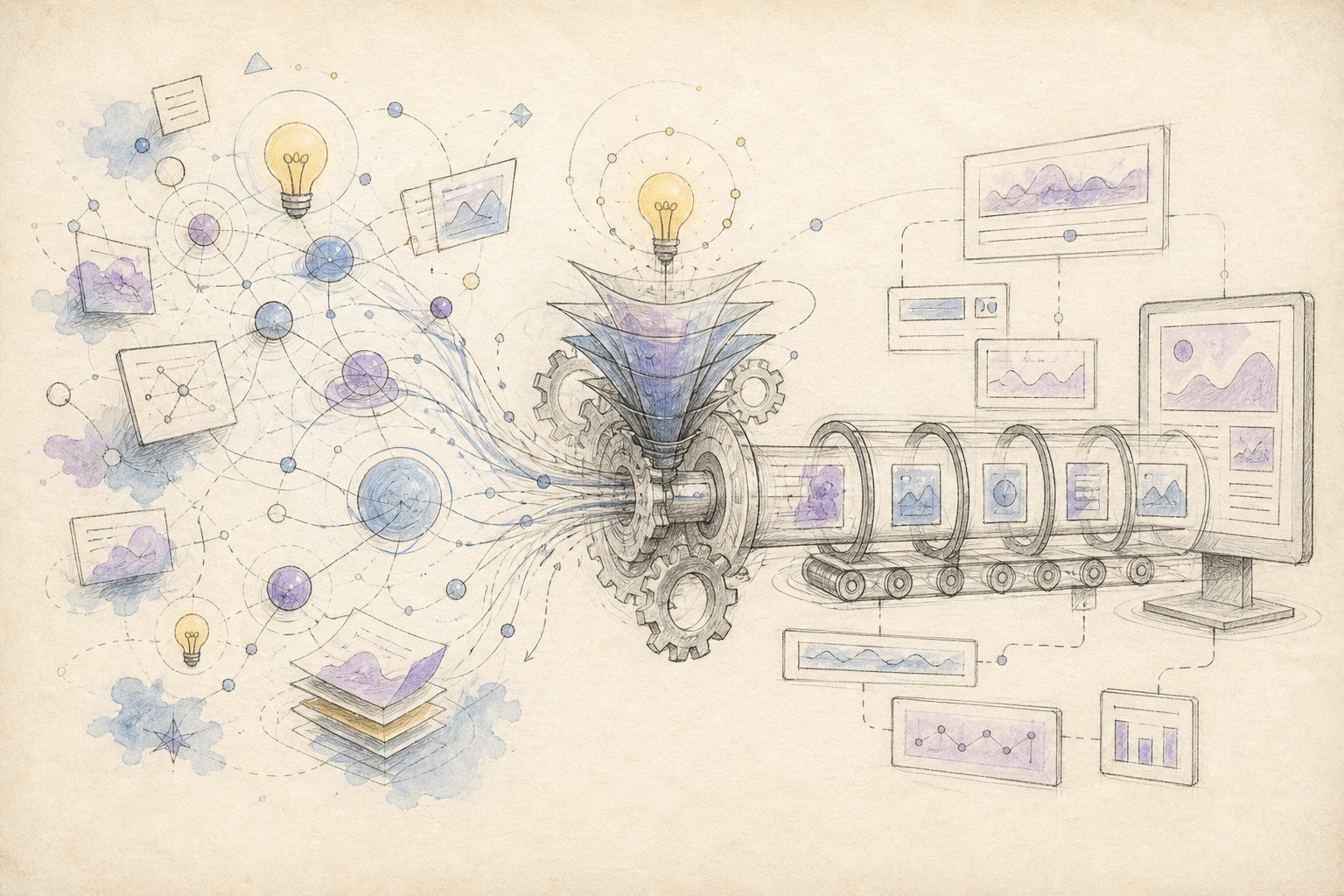
Illustration drawn for the production workflow — reused from the existing DramaSo image set.
The scarce resource on a live-action set used to be a free sound stage. Now it is a reason to keep a human in the shot.
Practical rule: If a shot could be covered by an extra, a warehouse, and a two-person lighting team, assume the AI pipeline already prices it at near zero. Do not compete there.
The Hengdian winter: jobs, wages, and the tourist-park exit
The wage data is uglier than the title counts. Global Times, citing CCTV, reported in August 2026 that pay for leading actors had shrunk by over 50 percent, mid-tier actors by more than 80 percent on average, and daily wages for bottom-rung extras had fallen into double digits. A 21-year-old actress who moved to Hengdian to shoot short dramas told the paper the hotel that used to be packed with crews now has “one or two, or none.” She now plays Huang Rong at Hengdian World Studios for tourists — nearly 13 hours a day in peak season, no script, face-to-face with visitors. The anxiety that left: “When I was filming, I kept worrying about the next job.”
A 36Kr report from 12 August described a seven-story internet-famous studio in Hengdian that once held more than 30 crews and, by April 2026, had one crew left — and that crew was doing live-action reshoots for AI short dramas. Several extras made expressions in front of a green screen so post-production could generate the rest. That is not “AI helping a shoot.” That is the shoot becoming a capture session for a generator.
PetaPixel, drawing on a Today interview, quotes a studio owner whose business is down 70 percent year on year, and an actor whose salary has fallen by half. Director Qingge Gao’s line is the one producers actually believe: people who watch mini-dramas can easily watch AI mini-dramas. Most of them do not care which one it is.
The jobs that moved were not evenly distributed. Entry-level production labor took the hit. Roles that still require taste — a director who can kill a bad take, a writer who can land an eighth-second reversal, a performer whose face carries a close-up — are the ones studios now have a reason to keep. For the unit economics of that split, see AI short drama production cost. For why shipping more titles stopped working, see China’s short drama saturation.
Decision filter: Ask of every role on the call sheet: would a viewer notice if this person were generated? If the honest answer is no, the market already has.
Likeness, consent, and the new legal fight
The second substitution is not a job disappearing. It is a face being reused without a new booking. The New York Times reported that celebrities and ordinary people threatened legal action after finding their likenesses in AI-generated microdramas, and that ByteDance later introduced restrictions on using real people’s faces in Seedance. A major streaming site announced a database of more than 100 actors whose likenesses could be available for future AI productions. That is a new contract, not a new camera.
If you run a small studio, the protection you owe talent is not a press quote. It is a clause: no training, no face-lock, no derivative episode without a written license that names the title, the episode range, and an expiry. If you are the talent, the same clause is the only thing that turns a one-day booking into residual-like control. Theme-park work is a labor market exit. A likeness license is a labor market rule.
I’d rather shoot fewer episodes with a signed face than ship a season that gets pulled because a lead recognized themselves in a feed they never walked onto.
The new negotiation is not day rate. It is whether the face can be reused after wrap.
Practical rule: Treat a face like a location permit. If it is not in writing, you do not have it — and a generator will not save you from the takedown.
What live-action still wins
Live-action still wins three things the generator is bad at, and they are not “cinematic quality” in the abstract.
Close-ups that have to survive a pause. Viewers skip on a seam. They stay on a face that holds an emotion for a beat longer than the cut wants. CNA’s interviews in Hengdian keep circling the same split: extras, basic lighting, cheap set crew and pure editing operators go first; directors, writers, and jobs that need artistic judgment are less exposed.
Bodies that interact with a real set. A slap, a fall, a crowded market, a hand passing a prop — these are still cheaper to direct than to prompt, because the failure mode is obvious in camera and expensive to inpaint later.
Trust, when the audience has been burned. The second-order cost of cheap AI content is not production. It is trust. If your title is selling a specific performer, a real location, or a true-story claim, generating the lead is a conversion tax. Disclose the pipeline on titles that are fully generated. Do not hide it and hope the comments stay kind.
None of this means “go back to a 30-person crew.” It means you spend the live-action budget on the shots where a seam would kill the episode, and you let the generator take the coverage. That is the same allocation we already use for long takes: the unit is not seconds, it is seams per minute of story. Put the longest, cleanest shot on the heaviest emotional beat.
How a small studio should split the pipeline
Here is the split I would actually run next week. It is not a manifesto. It is a call sheet.
- Write the season as live-action even if you will generate it. Lock the character sheet, the wardrobe bible, and the episode-ending ask before you open a generator. The AI script generator is for beat-timed pages, not for discovering the story in the render.
- Generate coverage. Shoot peaks. Establishing wides, walk-and-talks, and crowd texture go to the AI short drama generator. Confessions, slaps, reveals, and any shot that is the reason someone unlocks the next episode get a camera or a licensed performer.
- License faces up front, or do not use them. One page, named title, named episodes, expiry. No “we’ll sort it in post.”
- Keep one human in the cut. Someone who can kill a take because the emotion is fake, not because the resolution is low.
- Publish fewer titles, with a door. The feed is how you get found; a per-show page is how you get searched. That argument is already in the saturation piece — do not spend the savings from AI on making more interchangeable episodes.
| Work | Give it to AI | Keep live-action |
|---|---|---|
| Extra / crowd / warehouse coverage | Yes | No |
| Day-rate supporting faces you cannot license | No — recast or generate original | Only with a signed likeness |
| Peak emotion (confession, slap, reveal) | Only if the seam is hidden | Prefer camera or licensed lead |
| Script, hook, episode ending | Draft | Human kill-switch |
| Location / stunt / prop interaction | Rarely | Yes |
Practical rule: Protect the work a viewer would miss if it disappeared. Automate the work a viewer would not name.
The overseas expansion story is a different article — AI short drama goes global — and it does not cancel the labor story at home. Exporting a generated catalog is how a studio uses the new pipeline. It is not a reason to pretend Hengdian is fine.
Frequently asked questions
Did AI really replace 95 percent of Chinese microdramas?
In Q1 2026, yes for new titles generated entirely with AI. CNA, citing the China Netcasting Services Association’s April report, puts the count at about 128,000 titles, of which more than 95 percent — about 122,000 — had no cameras and no live actors. That is not the same as “95 percent of all viewing” or “95 percent of revenue.”
Are live-action short drama jobs gone?
The high-volume, low-skill bookings are gone or priced like extras in double-digit daily wages. Theme-park performance and licensed-face work are the two visible exits. Writer, director, and close-up performer roles are the ones a studio still has a reason to pay for.
Is it legal to use an actor’s face in an AI short drama?
Only if you licensed it. Unlicensed likenesses have already produced threats of legal action and platform restrictions. Write the title, the episode range, and the expiry. If it is not on the page, you do not have it.
Should a small studio still shoot anything?
Yes — the peaks. Generate the coverage. Shoot or license the shots that carry the unlock. A full live-action 80-episode package is now a cost structure the market will not pay for. A hybrid package is not nostalgia. It is how you keep the one thing AI still leaks: a face the audience believes.
The bottom line: The 95 percent figure is a labor number wearing a technology headline. If you run a studio, stop competing with the warehouse shoot and start competing with licensed faces, peak beats, and a pipeline you can defend. Start the first episode on a tool that treats the season as the unit.
Popular guides
More in this series
- Korean and Chinese Short Drama Recommendations: A 2026 Viewer's Guide
- AI Short Drama Goes Global: The 2026 Overseas Boom, Big Players, and Creator Payouts
- After Ten Thousand a Month: China's AI Short Drama Saturation and the Openings Left
- Seedance 2.5 for Short Drama: 30 Seconds Kills the Seam, 50 References Kill the Recast
- Microdrama Market 2026: The Data Guide to a $7.8B Industry
View all 10 articles in Short Drama Industry & Market →