/logo.webp)
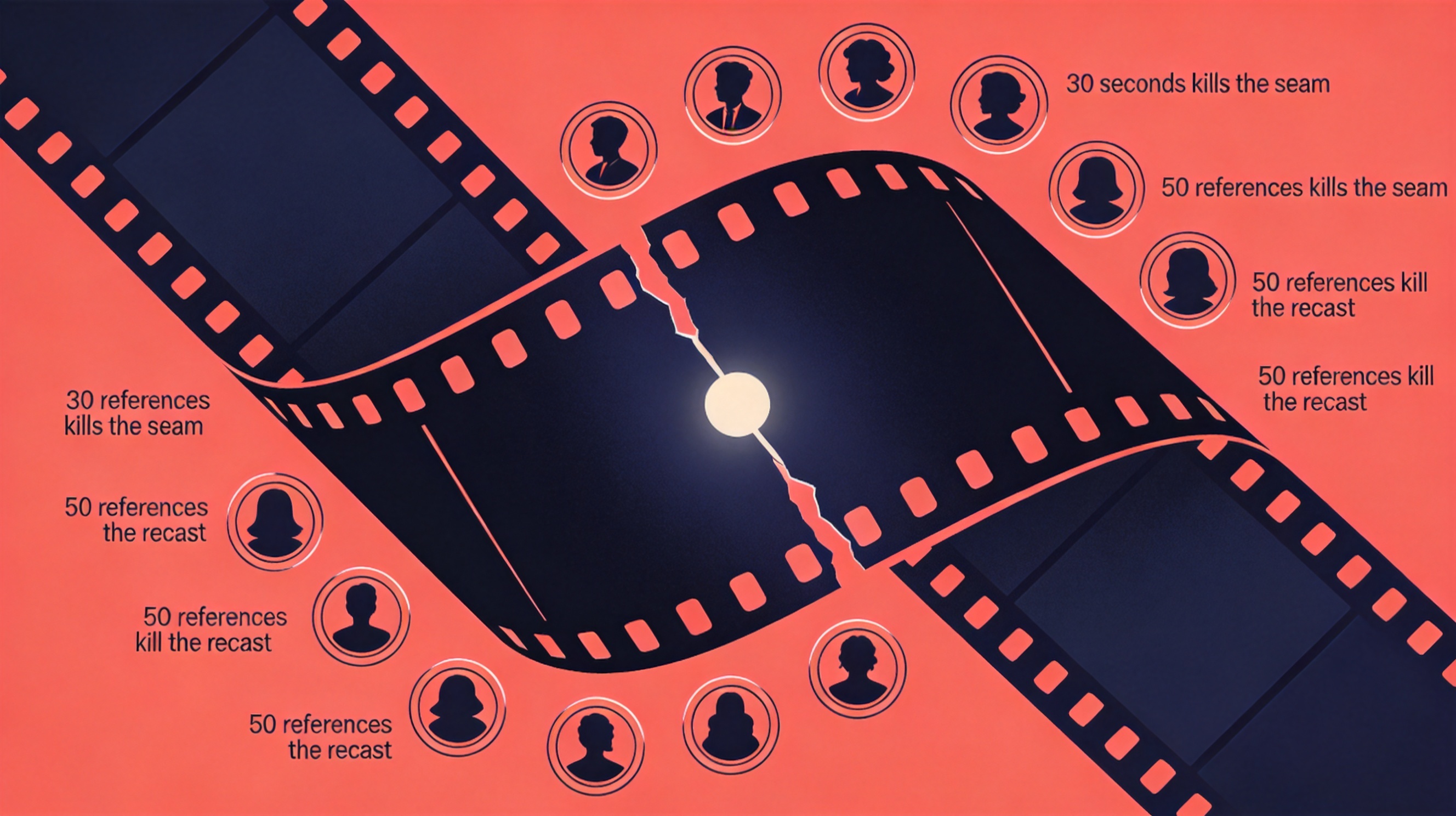
Seedance 2.5 for Short Drama: 30 Seconds Kills the Seam, 50 References Kill the Recast

Every AI video release gets read the same way: the number got bigger, so the videos get better. Seedance 2.5 is being covered as “30-second clips now,” and that framing is wrong for short drama in a specific, useful way.
Thirty seconds does not get you an episode. A vertical short-drama episode runs 60 to 120 seconds of multi-shot narrative, so a 30-second ceiling is still less than half of one episode. What 30 seconds does get you is one complete beat in one unbroken take — and the seam between stitched clips is the single most reliable tell that an AI drama was made by an amateur. That is the upgrade. Not the length.
Verified against public reporting and vendor notices as of 31 July 2026. This category re-ranks monthly; check the linked sources before you commit budget.
What ByteDance actually announced
Seedance 2.5 was unveiled on 23 June 2026 at ByteDance’s Volcano Engine FORCE conference in Beijing. The confirmed specs, per The Next Web’s coverage:
| Capability | Seedance 2.0 | Seedance 2.5 |
|---|---|---|
| Native single-shot length | ~15 sec | 30 sec |
| Resolution | Native 4K (10-bit) | Native 4K (10-bit) |
| Multimodal reference inputs | ~12 | Up to 50 |
| Audio | Unified audio-video architecture | Co-processed in the same latent space as visuals |
| Prompt adherence | Baseline | ~20% better (vendor claim) |
ByteDance skipped 2.1 through 2.4 entirely, jumping straight from 2.0 to 2.5 to signal a generational change rather than a point release.
Now the part most coverage buries. As of late July 2026 Seedance 2.5 is not something most readers of this post can use. It launched into closed enterprise beta, public access is gated to ByteDance-owned surfaces inside China — Dreamina (Jimeng), Doubao and CapCut — the public launch target slipped from “early July” to 31 July, and no official per-second API pricing has been published. No timeline has been offered for the United States.
Practical rule: Separate “announced” from “callable” before you re-plan a season around a model. A spec sheet you cannot invoke is a roadmap item, not a tool.
Illustration: DramaSo — the 2.0 → 2.5 delta, read through short-drama constraints.
The upgrade that matters is the seam, not the length
Here is the arithmetic that the “30 seconds!” headlines skip.
A short-drama beat — the confession, the slap, the reveal that the CEO was the delivery driver — typically runs 15 to 30 seconds of continuous screen time. Under a 15-second ceiling you generate that beat as two or three separate clips and butt them together. Every one of those joins is a place where the light shifts, the hair resets, the room tone jumps, and the coat changes shade. Viewers cannot name what is wrong. They just stop trusting the scene.
At 30 seconds, that same beat fits in one generation. You are not making longer videos; you are making fewer joins per minute of story. For a 90-second episode, the seam count on your emotional peaks drops from roughly two-to-three per beat to zero.
That reframe changes what you should do with the capability when you get it. The temptation is to spend 30 seconds on a sweeping establishing shot. The payoff is spending it on the dialogue beat you were previously forced to cut in half.
Practical rule: Spend the longest shot you have on your most emotional beat, not your prettiest one. Seams are cheap in an establishing wide and fatal mid-confession.
50 references is a season-scale lever
If you only read one number from this release, read this one: reference inputs went from about 12 to 50.
Duration is a shot-scale lever — it improves one generation. Reference capacity is a season-scale lever, because the thing that actually kills AI short dramas is not clip length. It is that your lead’s face drifts by episode seven. We made that argument at length in our AI video model comparison for short drama, and 2.5 is the first release that moves the number attached to it.
Fifty slots is enough to carry a genuine production bible into a single call: a full character sheet per lead (front, three-quarter, profile), wardrobe continuity plates, two or three location references, a lighting plate, and a style reference — for more than one character at once. For context on how unusual that is, the same TNW report notes Google’s Veo 3.1 accepts up to three reference images.
There is an honest catch, and it is the same one that applies to every model in this category: consistency holds within a generation. Fifty references do not give the model a memory of your protagonist next Tuesday in a fresh session. Cross-episode character lock is a workflow feature that has to live one layer above the model.

Screenshot: DramaSo — the reference library that survives from episode 1 to episode 40.
What 2.5 does not fix
Three things, and they are the three that decide whether you finish a season.
It does not give you an episode. Thirty seconds is a beat. A 90-second episode is still three to five generations that have to agree with each other on face, wardrobe, room and tone. Fewer seams is not no seams.
It does not remember anything. Every fresh session starts from zero. That is why the durable asset you build this month is not a prompt — it is the reference library and shot list you can re-feed to whichever model wins.
It is not priced. ByteDance has published no official per-second rate for 2.5. The only public signal is a leaked Dreamina credit rate of roughly 660 credits for a 30-second 720p clip, which sits above the existing Seedance 2.x per-second ladder (around $0.04 to $0.353/sec depending on tier). A longer maximum shot does not automatically mean cheaper output — token cost scales with width × height × frame rate, so a 30-second 4K take is a materially larger bill than two 15-second 720p ones.
Illustration: DramaSo — a 30-second 4K take against two 15-second 720p ones.
Practical rule: Budget as rate × seconds × takes-per-scene × scenes. A model that nails a beat in two takes beats a cheaper one that needs six, and a 30-second ceiling tempts you into burning full-length takes on drafts.
The prep that pays off before you get access
Nothing above requires waiting. The work that makes 2.5 worth having is work you can do today, and it transfers to Kling, Veo or Runway if the access timeline slips again.
- Rebuild your shot list in beat blocks, not clip lengths. Stop writing “shot 4: 6s.” Write “beat 2: the confession, ~24s, one take.” Our shot list template carries a duration column for exactly this — size the rows by the beat, then check the total against your model’s ceiling.
- Assemble the reference manifest per character, not per shot. Three angles, wardrobe plate, one lighting reference. That is the artifact 50 input slots are hungry for, and the artifact that survives a model change.
- Board the season, not the scene. Use the AI storyboard generator to fix camera and blocking before you spend a single generation credit, and the AI episode generator to keep episode 40 looking like episode 1.
That last point is the whole argument. A raw model gives you shots; a short drama is a season — one premise, one cast, one visual world, cliffhangers that pay off weeks later. DramaSo sits on that production layer: plan a season from one premise, lock each character once so portraits, wardrobe and assigned voice carry into every later episode, get word-level lip-sync and safe-zone captions, and export captioned native 9:16. Start with the AI short drama generator, or if you are still choosing a pipeline, read how to make an AI short drama for TikTok first — model choice gets easy once the workflow is concrete.
Illustration: DramaSo — choose the model for the shot, the studio for the season.
Practical rule: Every hour spent on reference discipline is model-agnostic. Every hour spent tuning one vendor’s prompt syntax expires with their next release.
FAQ
Can I use Seedance 2.5 right now?
Not in most markets. It entered closed enterprise beta after the 23 June 2026 unveiling, and public access at launch is limited to ByteDance-owned surfaces inside China — Dreamina (Jimeng), Doubao and CapCut. The public launch target moved from early July to 31 July 2026, and no availability timeline has been announced for the United States.
Does a 30-second shot mean I can generate a whole episode?
No. Vertical short-drama episodes typically run 60 to 120 seconds of multi-shot narrative, so 30 seconds is under half an episode. The real gain is that a single emotional beat — usually 15 to 30 seconds — now fits in one unbroken take instead of being stitched from two or three clips.
How much does Seedance 2.5 cost?
ByteDance has not published official per-second pricing as of 31 July 2026. The only public signal is a leaked Dreamina rate of roughly 660 credits for a 30-second 720p clip, against an existing Seedance 2.x ladder of about $0.04 to $0.353 per second by tier. Treat any firm number you see elsewhere as an estimate.
Is Seedance 2.5 better than Veo 3.1 for short drama?
They win on different axes. Seedance 2.5’s headline advantages are the 30-second native shot and up to 50 multimodal reference inputs versus Veo 3.1’s three. Veo 3.1 is generally available and generates 48kHz synchronized dialogue. For dialogue-heavy genres, availability plus lip-sync quality often outweighs reference capacity — see our full model comparison.
Will 50 reference inputs keep my lead consistent across episodes?
Only inside a single generation. More reference slots make one call far more controllable, but no current model remembers your protagonist in a fresh session next week. Cross-episode consistency is a workflow feature — character lock at the production layer — not a raw model capability.
What should I do while waiting for access?
Build the model-agnostic assets: a shot list written in beat blocks rather than fixed clip lengths, and a per-character reference manifest (three angles, wardrobe plate, lighting reference). Both transfer directly to whichever model you end up with, and both are what 50 input slots are designed to consume.
Popular guides
More in this series
- Microdrama Market 2026: The Data Guide to a $7.8B Industry
- TikTok PineDrama Explained: What Its Launch Means for Creators
- Character.AI Enters the Microdrama Race: How Chattable Characters Change Interactive Short Drama
- Cite 37 Short Drama Statistics (2026): Market Size, Growth & Apps
- What Is an AI Short Drama? (And Is the Drama You're Watching AI-Generated?)
View all 10 articles in Short Drama Industry & Market →